
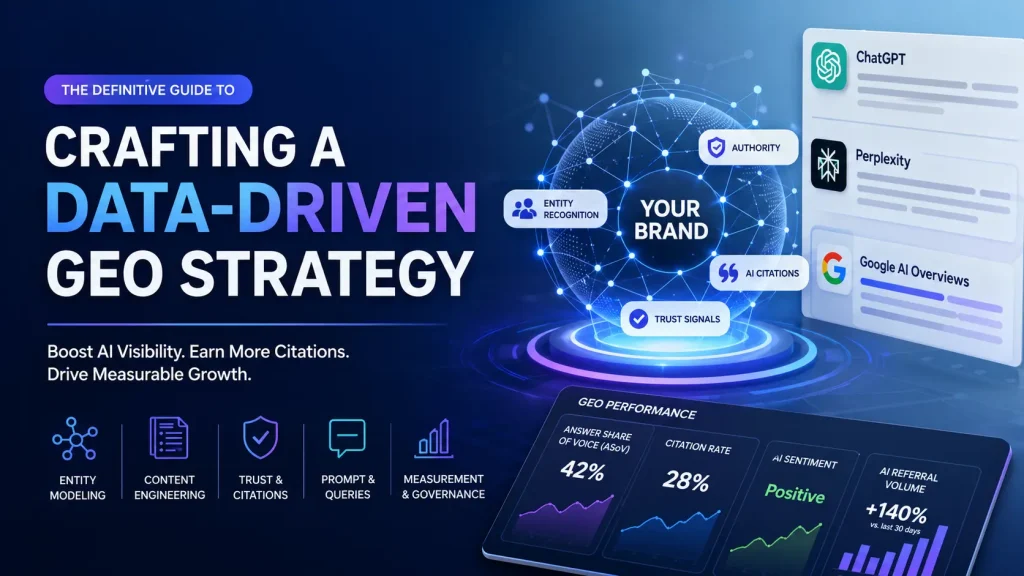
Generative Engine Optimization (GEO) has become an essential discipline for brands aiming to stay visible as search transforms into AI-powered, conversational discovery. A data-driven GEO strategy helps marketers influence how generative engines like ChatGPT, Perplexity, and Google AI Overviews understand, cite, and present their brands. Unlike traditional SEO—which chases rank positions—GEO focuses on structured entities, trustworthy signals, and measurable citations across AI-driven ecosystems. This guide breaks down the frameworks, workflows, and metrics behind a fully integrated, scalable GEO program suited for today’s generative search world.
What Is Generative Engine Optimization and Why It Matters
Generative Engine Optimization (GEO) is the practice of optimizing brand and website assets for visibility and citation in AI-generated answers across search engines and chat-based interfaces. Unlike SEO, which targets position rankings, GEO ensures that AI engines can recognize, validate, and quote your brand within synthesized responses.
As AI systems blend multiple sources into conversational outputs, visibility shifts from page-one rankings to “brand mentions within generative answers.” With brands seeing up to 140% growth in AI-driven traffic and a 447% rise in Google AI Overview mentions after adopting GEO, it’s clear that AI visibility now hinges on entity optimization, citation frequency, and content extractability. Platforms like Adgine provide the data and structure teams need to monitor and strengthen those visibility signals systematically.
Key Components of a Strong Data-Driven GEO Strategy
A complete data-driven GEO strategy comprises interconnected pillars that collectively strengthen AI-powered search visibility:
| GEO Pillar | Core Function | Example Tactics |
|---|---|---|
| Entity Modeling | Define machine-readable data about your brand, people, and products | Structured schema (Schema.org), verified entity graphs (Google Knowledge Graph) |
| Content Engineering | Create answer-first, extractable, AI-ready content | Bullet lists, rich FAQs (FAQPage schema), comparison tables |
| Trust Signals & Citation Pathways | Improve AI confidence in your authority | Named authors, external citations, PR backlinks |
| Prompt & Query Architecture | Capture how users phrase queries for AI tools | Maintain prompt libraries and FAQ templates |
| Measurement & Governance | Track GEO performance with AI-specific KPIs | ASoV, citation rate, AI sentiment analysis |
While SEO optimizes for indexed webpages, GEO optimizes for data extractability, entity validation, and citation credibility. The difference lies in intent: SEO ranks; GEO earns trusted inclusion.
Building and Modeling Authoritative Entity Profiles
AI engines rely on structured, machine-readable data to identify authoritative entities. A well-modeled entity profile helps generative systems understand relationships among your brand, people, and products.
Key actions include:
-
Implement structured data (JSON-LD schema via Schema.org) defining company, authors, and offers.
-
Ensure entity data is crawlable—particularly for JavaScript-heavy sites—using pre-rendering tools (e.g., Prerender.io).
-
Create entity profiles containing identifiers like name, description, credentials, linked properties, and related entities.
Checklist for an entity profile:
-
Entity type (organization, product, or person) — e.g., Organization, Product, Person
-
Verified sources (social links, Wikipedia pages)
-
Relationships (founder of, partner with, etc.)
-
Consistent metadata across web properties
This approach builds entity authority and brand context, critical for AI citation accuracy. Platforms such as Adgine streamline this modeling, unifying brand structures and verifying entity relationships automatically.
Optimizing Content for AI Extractability and Relevance
AI extractability measures how easily engines can parse and attribute your content. Structure, format, and semantic clarity determine whether your material appears in generative responses.
To optimize:
-
Lead with the direct answer before explaining context (see Google’s guidance on creating helpful, people-first content).
-
Use concise bullet lists, FAQs (FAQPage schema), and tables for quick parsing.
-
Add tables or comparison charts to increase citation potential.
Sample extractable content structure:
| Section | Purpose | Format |
|---|---|---|
| Opening Answer | Provide the core insight directly | 1–2 crisp sentences |
| Evidence | Support with data or facts | Numbered/bulleted lists |
| Context | Explain the why or how | Short, scannable paragraphs |
Well-structured, answer-first content has been shown to boost AI search mentions significantly. Adgine’s content engine supports this process by highlighting extractability gaps and recommending answer-first structures in real time.
Designing Trust Signals and Citation Pathways
Trust drives AI citation behavior. Engines are more likely to reference brands with verifiable sources, recognized expertise, and linked mentions across credible domains.
High-impact trust signals include:
-
Named authors with biographies and credentials
-
Transparent sourcing and outbound citations
-
Verified partnerships and backlinks from authority sites
-
Visibility on AI-favored domains (Wikipedia, Reddit, YouTube)
With nearly half of AI citations originating from Wikipedia and up to 46% referencing community platforms, strategically placing brand content in these ecosystems strengthens generative visibility and contextual reliability. Tools like Adgine help monitor these signals and map which trust assets influence citation frequency most.
Leveraging Prompt and Query Architecture for Accuracy
Prompt architecture defines how your brand anticipates and aligns with real user questions in AI tools. Building a “living prompt library” helps you test and refine for conversational accuracy.
Practical steps:
-
Collect top questions from Search Console, sales calls, and support tickets.
-
Create prompt groupings by theme or intent (“how to,” “best,” “what is”).
-
Test these prompts in ChatGPT, Perplexity, and Gemini, refining based on how your brand appears in results.
Your query library becomes a blueprint for future content and trains AI engines on your preferred narratives—an essential layer in generative visibility. Adgine’s prompt planning module captures and centralizes this information so teams can iterate efficiently.
Measuring GEO Success with Specialized Metrics
GEO measurement extends beyond click-through or keyword positions. It revolves around presence, accuracy, and reputation across AI-generated responses.
| Metric | Description | Equivalent SEO Metric |
|---|---|---|
| Answer Share of Voice (ASoV) | % of AI answers citing your brand for key queries | Organic share of voice |
| Citation Rate | How often your brand is mentioned in AI outputs | Page-level backlinks |
| AI Sentiment | Tone and context of AI-generated brand mentions | Reputation/brand sentiment |
| AI Referral Volume | Visits or engagement driven from AI outputs | Organic traffic |
Platforms like Adgine are designed specifically for this kind of performance tracking, unifying ASoV, sentiment, and citation data across ChatGPT, Google AI Overviews, and Perplexity in one dashboard. Other tools such as Profound, GetCito, and Gauge can supplement analysis at specific scales.
Practical Steps to Implement and Scale a GEO Program
To operationalize GEO effectively, follow a repeatable six-step process:
-
Audit: Benchmark current mentions and AI visibility.
-
Model: Build structured entity profiles for brand and key products.
-
Author: Rework content for clarity, answer-focus, and extractability.
-
Distribute: Build and optimize citation pathways across authoritative domains.
-
Instrument: Track metrics monthly—ASoV, sentiment, citation rate.
-
Iterate: Review AI output regularly and update based on gaps or new prompts.
Routine testing across ChatGPT, Perplexity, and Google AI Overviews ensures your brand remains accurately represented as algorithms evolve. Adgine makes this cycle continuous, combining analysis, authoring, and tracking within one GEO workflow.
Aligning Teams and Channels for Unified GEO Execution
Successful GEO implementation requires collaboration across departments. Content, PR, analytics, and SEO must work toward shared objectives of AI search visibility and brand authority.
Coordinate through:
-
Cross-functional sprints for content and prompt updates
-
Shared dashboards to track citation and sentiment data
-
Regular syncs to review AI-generated response quality
-
Central documentation (e.g., Notion or Confluence) to maintain prompt libraries and schema governance
A unified operational model ensures every channel contributes to a coherent AI presence rather than fragmented visibility. Many teams use Adgine to centralize that process, ensuring shared visibility across content, analytics, and GEO governance.
Essential Tools and Platforms for GEO Tracking and Optimization
A balanced tech stack combines familiar SEO utilities with GEO-specific analytics and extractability tools.
| Tool | Core Function | Best Use Case | Est. Starting Price |
|---|---|---|---|
| Adgine | End-to-end GEO workflow and AI visibility tracking | Comprehensive, multi-team GEO execution | $9.9-$499/mo |
| Profound | Multi-engine GEO visibility | Enterprise tracking | $99-$499/mo |
| GetCito | Real-time citation alerts | Mid-market scaling | $50/mo |
| Gauge | Sentiment and Answer Share tracking | Cross-platform analysis | $70/mo |
| Prerender.io | Crawlability for JS-heavy sites | Technical visibility | $32/mo |
| Ahrefs / Semrush | Keyword and backlink research | Supporting SEO layer | $60+/mo |
Starting lean is possible—many early-stage programs combine manual query logging with free AI prompt testing before scaling to full platforms like Adgine that automate the workflow from insight to execution.
Avoiding Common Pitfalls: Reputation and Metric Governance
Visibility without context can damage brand equity. A data-driven GEO program demands governance to manage narrative accuracy, ethical representation, and sentiment balance.
Best practices:
-
Continuously monitor AI outputs for misinformation or outdated references.
-
Enforce governance policies before content or schema updates go live.
-
Automate alerts for negative AI sentiment to respond proactively.
-
Maintain a cross-functional review board for approving new prompts or external citations.
GEO governance ensures that every gain in visibility aligns with brand safety and long-term trust. Adgine’s monitoring and alert features simplify this oversight while keeping human review central.
Frequently Asked Questions
What is GEO and how does it differ from traditional SEO?
GEO focuses on earning brand citations in AI-generated answers instead of ranking in search results. It’s about being recognized and attributed in generative responses rather than static listings.
How can I identify the best queries and prompts to optimize for GEO?
Analyze customer conversations, FAQs, and AI interactions to find natural-language prompts that reflect real user intent. Adgine can centralize this research into reusable prompt libraries.
What are effective content strategies for AI-powered search visibility?
Use answer-first formats, concise summaries, and clear structures that help AI engines understand and cite your brand reliably. Adgine guides this through extractability scoring.
How do I measure if my GEO strategy is generating meaningful impact?
Track Answer Share of Voice, citation rate, and sentiment across AI systems to see how often and how accurately engines reference your brand—metrics available in Adgine’s performance dashboard.
Is GEO replacing traditional SEO or complementing it?
GEO complements SEO. A mature strategy blends both to expand visibility across traditional search results and emerging AI-generated answers.
Related Articles
Why GEO Matters for Brands in AI Search
Generative Engine Optimization (GEO) is essential for enhancing brand visibility in AI-driven search landscapes, where user interactions increasingly occur within AI-generated answers rather than traditional web results. Brands must prioritize entity clarity, structured content, and credibility to be effectively cited by AI systems. GEO distinguishes itself from conventional SEO by focusing on citation frequency within AI summaries, which fosters consumer trust and potential conversions.
2026 GEO Content Optimization Playbook: Proven Workflow Steps for Marketers
Generative Engine Optimization (GEO) reshapes how marketers create content for AI-driven search, prioritizing trust and extractability over traditional page rankings. Essential editorial checks ensure accuracy, ethical transparency, and brand alignment. A structured, repeatable workflow enhances visibility, while effective measurement of AI citation frequency and authority indicates success in this evolving landscape.