
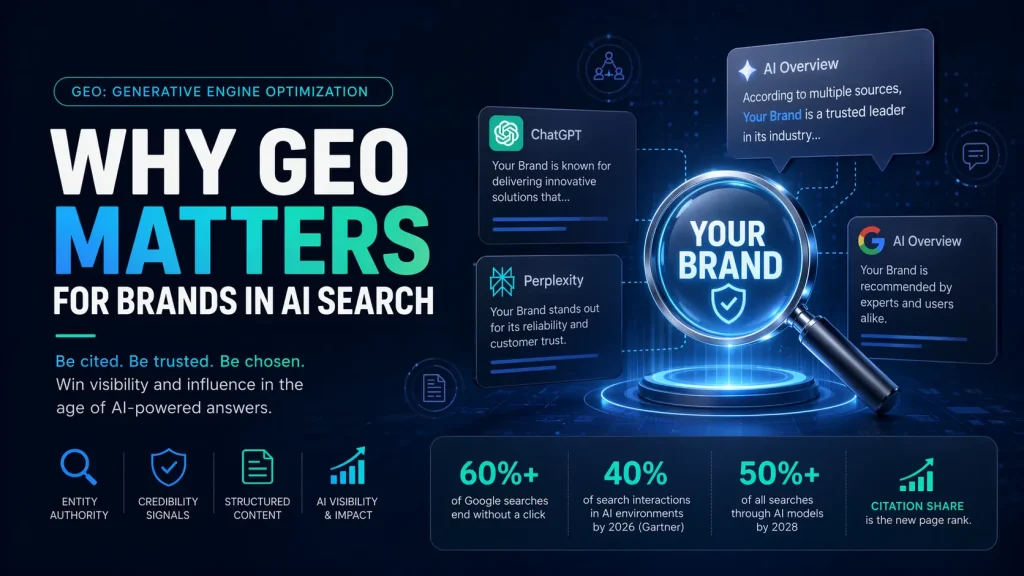
Generative Engine Optimization is fast becoming the new frontier of digital visibility. As AI-driven engines like ChatGPT, Perplexity, and Google’s AI Overviews reshape how users get information, brand discovery increasingly happens inside AI-generated answers rather than on search result pages. GEO is the practice of optimizing content so that generative systems can understand, trust, and cite your brand directly within their conversational responses. With nearly 60% of Google searches now ending without a click and Gartner predicting that 40% of all search interactions could occur within AI environments by 2026, optimizing for this “zero-click” world is no longer optional. Brands that master GEO will earn authority, visibility, and influence at the very point of AI-powered decision making. Platforms like Adgine now help brands operationalize this process through structured workflows and real-time visibility tracking across AI engines.
Strategic Overview
Generative Engine Optimization is the strategic evolution of search optimization—built for a world where users ask questions and receive answers, not lists. In this environment, visibility isn’t about ranking; it’s about being referenced. AI answer engines synthesize multiple sources, so brands must focus on clarity, credibility, and structure to appear as authoritative citations. The move toward zero-click discovery means users increasingly rely on AI-generated summaries. As a result, being cited or recommended inside those answer sets defines whether a brand is discovered or bypassed. Tools such as Adgine’s GEO monitoring make it practical for teams to track this inclusion consistently and adapt content strategies based on measurable AI visibility signals.
The Rising Importance of GEO for Marketers
Marketers are investing in GEO because decisions are forming inside AI interfaces. Visibility today means being referenced where user confidence is built—not just indexed on page one of Google.
Traditional SEO relies on clicks and rank positions, while GEO focuses on inclusion within generative answers. The rise of Google’s AI Overviews and conversational interfaces has accelerated this shift, as organic traffic from traditional search continues to decline. For teams navigating that transition, understanding GEO vs SEO helps clarify which signals belong to ranking pages and which support AI answer inclusion.
| Dimension | SEO | GEO |
|---|---|---|
| Goal | Rank in search results | Be cited in AI-generated answers |
| Primary User Intent | Click and browse | Ask and receive |
| Optimization Focus | Keywords and backlinks | Entity clarity and structured content |
| Performance Metric | Click-through rate | Citation frequency and recommendation presence |
| Discovery Interface | Web search results | AI Overviews, chat engines, zero-click platforms |
AI discovery now relies on entity authority—the verified, well-defined representation of who or what your brand is across the web. For marketers, the critical question has become: is your entity clear and trusted enough to be surfaced by AI? Adgine provides entity-level diagnostics that help answer this directly, mapping how AI engines interpret, reference, and attribute your brand across prompts and responses.
How GEO Connects to AI-Generated Answers
AI-generated answers operate through layered processes that pull from trusted, well-structured content. When users type a question into an AI assistant, the system retrieves, interprets, and summarizes data from multiple entities. To ensure inclusion in these summaries, brands must strengthen:
-
Entity clarity: ensuring your brand is uniquely identifiable.
-
Structured content: using FAQ schema, bullet points, and metadata AI can interpret.
-
Credibility signals: verified authorship, reviews, and high-quality third-party citations.
Flow of visibility:
-
Corpus inclusion – AI indexes your public brand content.
-
Entity detection – algorithms match mentions to a known brand identity.
-
Answer attribution – your brand is quoted or used as part of a synthesized response.
Getting this right means users encounter your brand directly within the conversation, not just as a secondary link. Adgine’s GEO insight engine makes these visibility chains transparent, so teams know exactly how their content feeds AI outputs.
GEO’s Role in Brand Discovery within AI Interfaces
In AI-first discovery journeys, brand reputation and visibility are reconstructed by how clearly and consistently entities appear across AI’s data sources. A brand optimized for entity clarity is not only visible in Google’s AI Overviews but also cited in ChatGPT responses and surfaced within Perplexity’s conversational threads. Consider how product comparisons or service recommendations are increasingly surfaced via AI-generated summaries rather than external websites.
For marketers, influence is now measured by citation depth—how often your brand is chosen, referenced, or recommended by AI models. As brand citation frequency increases, so does consumer trust and assisted conversion potential. Adgine helps teams benchmark citation depth over time, linking it to tangible business outcomes and competitor brand visibility in AI platforms.
The Shift from Traditional SEO to GEO Strategies
SEO and GEO share foundations, but their end goals diverge. SEO still matters for discoverability; GEO ensures comprehension, summarization, and attribution by AI systems.
| Element | SEO | GEO |
|---|---|---|
| Output Landscape | Search results pages | Generative AI answers |
| Optimization Scope | Webpages and keywords | Entities, content structure, trust signals |
| Primary Data Consumer | Search algorithm | Language model |
| Visibility Metric | Page rank | Inclusion in answer set |
The rollout of AI Overviews has sharply reduced organic click-through rates—from roughly 25.8% to 7.4% in some queries—illustrating why focusing solely on traditional SEO misses where visibility truly happens. GEO requires shifting from page-level optimizations to entity-level readiness, ensuring AI models can easily interpret your brand context. Adgine’s platform supports that shift through integrated workflows spanning topic discovery, data-informed content creation, and ongoing AI visibility tracking.
Core Elements That Drive GEO Success
Success in GEO depends on signal clarity across three core pillars:
-
Entity authority – consistency in how your brand, products, and experts are represented across the web.
-
Credibility signals – clear authorship, third-party mentions, and trustworthy references.
-
Structured content – schema markups, FAQs, concise summaries, and answer-ready formats.
Immediate actions for brands:
-
Audit and unify brand mentions and “About” data across all major platforms.
-
Encourage coverage in reputable, high-authority publications.
-
Implement structured data to help AI engines parse and reuse content accurately.
| Optimization Type | Primary Focus | Example Tactics |
|---|---|---|
| SEO | Keyword visibility | Meta tags, backlinks, content updates |
| GEO | Entity comprehensibility | Schema, authority alignment, external credibility |
Adgine’s GEO framework helps teams operationalize these pillars—turning ad hoc experiments into a repeatable data-driven GEO strategy grounded in measurable results.
Measuring Brand Visibility in AI Search
GEO success isn’t measured by traffic—it’s measured by presence. The key is knowing how often and where your brand is appearing within AI answers.
Core GEO metrics:
-
Share of Model (SOM): How frequently your brand appears in generative answer sets for target topics.
-
AI citations: The number of direct or paraphrased references in AI responses.
-
Entity mentions: Detection across different AI engines and answer interfaces.
-
Assisted conversions: Engagements initiated after users interact with AI-generated brand mentions.
A structured GEO measurement routine might include:
-
Diagnose entity presence with brand + topic queries in AI engines.
-
Track citations and frequency over time.
-
Identify missing citations and adjust structured data or credibility sources.
-
Benchmark Share of Model growth relative to competitors.
Adgine automates much of this analysis, offering real-time insight into brand perception, citation share, and visibility momentum across engines. These workflows become stronger when teams define the right AI visibility metrics for citation frequency, entity mentions, sentiment, and assisted conversions.
Ethical and Regulatory Considerations in GEO Practices
As AI regulations tighten—driven by frameworks like the EU AI Act and California’s AI transparency guidelines—marketers must align GEO strategies with ethical standards. Transparent authorship, source accuracy, and authentic brand signals enhance long-term trust with both users and AI systems.
Ethical GEO checklist:
-
Maintain visible, fact-checked authorship.
-
Use verifiable data sources—no synthetic or manipulative references.
-
Attribute external content accurately.
-
Track provenance for all AI-optimized materials.
Responsible optimization not only safeguards compliance but also strengthens how AI models evaluate brand trustworthiness. Adgine’s transparent data model supports this by showing how content is used and referenced across engines.
Future Trends Shaping GEO and AI Search Visibility
The interplay between AI and user behavior signals an irreversible shift:
-
Zero-click searches now exceed 60% of all Google interactions.
-
AI Overviews appear in nearly 39% of queries across some regions.
-
By 2028, half of all searches are expected to route through generative engines.
-
Traditional search may decline by 25% by 2026 as discovery migrates to AI channels.
AI’s corpus increasingly includes Reddit, Quora, and YouTube transcripts—diversifying how brand information gets indexed and cited.
| Year | Milestone | Visibility Implication |
|---|---|---|
| 2024 | Rapid AI Overview rollout | Visibility shifts to answer panels |
| 2026 | 40% of searches occur in AI interfaces | GEO becomes a primary marketing function |
| 2028 | 50%+ of all queries through AI models | Brand mention share replaces page rank as success metric |
The brands that adapt now—integrating GEO into their broader content systems—will be the ones positioned to lead discovery in AI-first environments. Adgine equips these teams with the intelligence and workflow discipline to make that shift systematically and sustainably.
Frequently Asked Questions
What is the difference between SEO and GEO?
SEO focuses on ranking content in traditional search engines, while GEO ensures that AI systems can process, understand, and quote your brand in their direct answers.
Why is GEO critical for brand visibility in AI search now?
As users rely on AI assistants for quick answers, GEO helps brands earn citations inside those answers rather than being overlooked in traditional search results.
What are the main components of an effective GEO strategy?
Clear entity authority, third-party credibility, and structured, AI-friendly content form the foundation—capabilities Adgine helps teams manage end to end.
How can brands test their visibility in AI answer engines?
Run target and branded queries in AI platforms, track how frequently your brand appears, and use Adgine to monitor and refine entity and citation signals consistently.
How does structured content improve AI citation and discovery?
Structured formats like FAQ schema and concise summaries help AI interpret and accurately cite brand information within generated answers, which platforms like Adgine can help standardize and measure.
Related Articles
2026 GEO Content Optimization Playbook: Proven Workflow Steps for Marketers
Generative Engine Optimization (GEO) reshapes how marketers create content for AI-driven search, prioritizing trust and extractability over traditional page rankings. Essential editorial checks ensure accuracy, ethical transparency, and brand alignment. A structured, repeatable workflow enhances visibility, while effective measurement of AI citation frequency and authority indicates success in this evolving landscape.
GEO Tools vs Traditional SEO Platforms: How to Choose in 2026
Generative Engine Optimization (GEO) tools enhance content for AI citation in platforms like ChatGPT, distinguishing themselves from traditional SEO, which emphasizes organic search rankings. GEO tools track brand mention frequency and facilitate AI visibility across multiple engines, while traditional SEO focuses on keyword performance. The selection of tools should reflect specific organizational needs and budget considerations.