
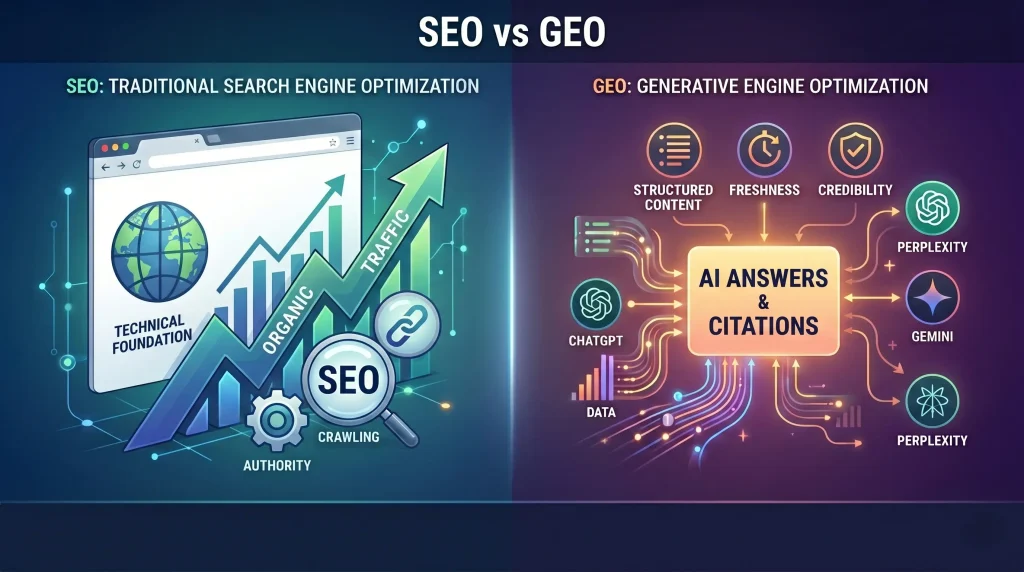
What’s the real difference between GEO and SEO — and how do they fit together in a world shifting toward AI-driven search? The answer lies in understanding how information is discovered and presented today. Search Engine Optimization (SEO) helps web pages rank on Google or Bing results pages, while Generative Engine Optimization (GEO) ensures content is recognized, cited, or recommended within AI-generated summaries produced by platforms like ChatGPT, Perplexity, Gemini, or Google AI Overviews. Instead of competing, the two work hand in hand: SEO builds technical and topical authority, while GEO translates that authority into visibility within AI answers—strengthening a brand’s credibility and reach across both human and machine audiences. Platforms such as Adgine now make it possible to manage both workflows together, turning GEO from experimentation into a systematic visibility strategy.
| Aspect | SEO | GEO |
|---|---|---|
| Core Goal | Rank in search results | Be cited in AI-generated answers |
| Main Platforms | Google, Bing, Yahoo | ChatGPT, Perplexity, Google AI Overviews |
| Content Focus | Keywords, backlinks, technical structure | Clarity, recency, structured data, and citations |
| Key Metric | Rankings & traffic | Citations & AI mentions |
| Optimal Format | Long-form pages | Structured, fact-based snippets |
Understanding GEO and SEO Fundamentals
Generative Engine Optimization (GEO) shapes content so AI systems can easily interpret, cite, and summarize it inside conversational answers. It values structured data, freshness, and credible sourcing—key signals that make content “AI-citable.” Adgine’s AI-first platform helps teams identify these signals and track how brands are referenced across major AI engines.
Search Engine Optimization (SEO) improves visibility within traditional search engines. It emphasizes keyword relevance, backlinks, and crawlable architecture to attract organic traffic.
In short, GEO optimizes for AI citation, while SEO optimizes for search ranking. Both rely on strong information structure and trustworthy signals.
Key Terms
-
AI Overview: A snapshot answer box generated by AI models summarizing multiple web sources (learn more)
-
Structured Content: Clearly formatted content (tables, headings, schema) enabling easier AI parsing
Key Differences Between GEO and SEO
While SEO rewards evergreen authority, GEO favors current, concise, and well-attributed content that AI can quote directly.
| Factor | SEO | GEO |
|---|---|---|
| Discovery Model | Crawling and indexing | Retrieval-augmented generation (RAG) |
| Primary Goal | Rank for organic traffic | Gain citations in AI responses |
| Ideal Format | Long-form, keyword-led | Condensed, structured, source-backed |
| Freshness Value | Moderate | High; updates often needed |
| Metrics | Positions, clicks, CTR | AI mentions, citations, referral traffic |
Example: Health publishers now balance detailed, SEO-optimized guides with regularly updated GEO snippets that AI engines can cite directly—keeping both rankings and AI visibility active.
How GEO and SEO Work Together in Modern Content Strategy
SEO ensures your content is findable; GEO ensures it’s reference-worthy. The strongest strategies integrate both.
Practical workflow:
-
Maintain technical SEO foundations: speed, sitemaps, and crawlability
-
Add GEO elements: structured definitions, metadata, and reference blocks
-
Refresh priority pages frequently to sustain AI recognition
Vertical balance varies—e‑commerce might skew 70% SEO / 30% GEO, while healthcare may lean 45% SEO / 55% GEO to emphasize recency and credibility. Using a unified workflow in platforms such as Adgine helps teams manage both layers consistently and future‑proof overall visibility through a measurable GEO strategy.
Essential SEO Practices for AI Search Optimization
Even as AI transforms discovery, classic SEO still underpins performance. Clean structure, internal linking, and semantic clarity remain foundational—and support AI readability.
Modern SEO-for-AI checklist:
-
Keep strong technical SEO (page speed, XML sitemaps)
-
Add schema markup for FAQs, HowTo, Review, or Product data
-
Use clear headings and concise, fact-rich sections
-
Include expert citations and verified data points (helpful, reliable, people-first content)
-
Refresh your best-performing pages regularly
Structured tables and lists improve extractability—a major factor influencing AI citation readiness. Adding visuals or video can extend reach within multimodal AI environments.
The Biggest Risks of Relying on SEO Alone in an AI Search Landscape
Depending exclusively on SEO limits visibility in AI ecosystems. Gartner forecasts suggest up to a quarter of traditional search volume may shift to AI interfaces by mid‑decade (source).
Risks of an SEO-only approach:
-
Content may remain invisible to AI summaries if not GEO-optimized
-
Blocking AI crawlers can erase future brand presence across Overviews or chatbots (learn about GPTBot/robots.txt controls)
-
Missed referral traffic from AI surfaces, which often convert better
To check current visibility, test queries on ChatGPT, Gemini, or Perplexity.ai and see whether your brand appears in AI citations. Adgine users can automate this process and track changes over time.
Measuring Success: Metrics for SEO and GEO
SEO metrics track ranking and engagement: impressions, clicks, and CTR. GEO metrics measure AI-driven visibility: citations, mentions, and referral traffic.
| Category | SEO | GEO |
|---|---|---|
| Visibility Metric | SERP ranking | AI citation frequency |
| Engagement Metric | Click-through rate | Referral traffic from AI |
| Authority Signal | Backlinks, domain trust | Mentions within AI summary answers |
To evaluate GEO performance, track priority queries, monitor citations across major AI engines, and log referral data through specialized tools or observation. Platforms like Adgine unify this tracking, correlating keyword-based and AI-based visibility in one workflow for clearer performance insight.
Best Practices to Integrate GEO and SEO for Sustainable Visibility
Sustainable visibility requires a single, integrated optimization model. Key actions include:
-
Audit high-performing SEO pages for GEO readiness (structure, freshness, citations)
-
Refresh key content every 20–30 days to maintain inclusion potential
-
Add question-based subheads, concise definitions, and attributed stats
-
Use schema markup for FAQs or summaries
-
Quote credible experts to build trust and authority
Step-by-step: Run a technical SEO audit → integrate extractable snippets → monitor GEO and SEO metrics → iterate for balance. A repeatable GEO content optimization workflow helps turn this sequence into a scalable operating model. Adgine structures these stages into a repeatable workflow, helping teams continuously refine performance without reinventing processes.
Emerging Trends in AI-Powered Search and Their Impact on SEO and GEO
Search is evolving fast. Nearly 90 million U.S. users are projected to adopt generative AI search tools by 2027. AI engines reward clear, trustworthy, multi-format content—especially from authoritative domains.
As no-click searches rise (roughly 60% of queries) (study), inclusion in AI-generated responses becomes a major growth lever. Meanwhile, multimodal GEO—combining text, imagery, and video—broadens brand exposure across AI surfaces.
Forward-looking brands are already integrating GEO and SEO together. Tools like Adgine help them anticipate changes, monitor AI perception, and sustain discoverability in this new discovery layer.
Frequently asked questions
What is the main difference between GEO and SEO?
GEO focuses on earning citations inside AI-generated answers, while SEO targets visibility on traditional search results pages.
Can SEO alone ensure visibility in AI-driven search results?
No. High SERP rankings don’t guarantee mention in AI answers unless content follows GEO-informed structure—Adgine helps identify and close those gaps efficiently.
How do I optimize content to be included in AI-generated answers?
Use structured formats, up-to-date data, and credible sources; schema markup enhances AI readability and citation potential.
Does achieving a top Google ranking guarantee AI search inclusion?
No. A top SERP position doesn’t automatically mean inclusion in AI-generated responses.
Should businesses focus more on GEO or SEO in the current search landscape?
The best approach is balanced—SEO for organic reach, GEO for authority within AI summaries. Platforms like Adgine make maintaining that balance practical and measurable.
Related Articles
The Definitive Guide to Diagnosing AI Content Citation Gaps
AI-driven search platforms are crucial for content visibility, yet many brands are not cited in these sources. This guide outlines methods to diagnose and rectify citation gaps, emphasizing the importance of content structure, technical SEO, verifiable data, and continual monitoring to enhance AI recognition and authority.
7 Proven Steps to Write Content for AI Search Engines
AI-powered search is transforming information discovery and citation. Content optimization for AI engines like ChatGPT involves clear, structured answers and original data. A seven-step guide details strategies to create trusted, machine-readable content. Key practices include concise responsiveness, structured formatting, author credibility, and regular updates to enhance visibility and reliability in AI-generated responses.