
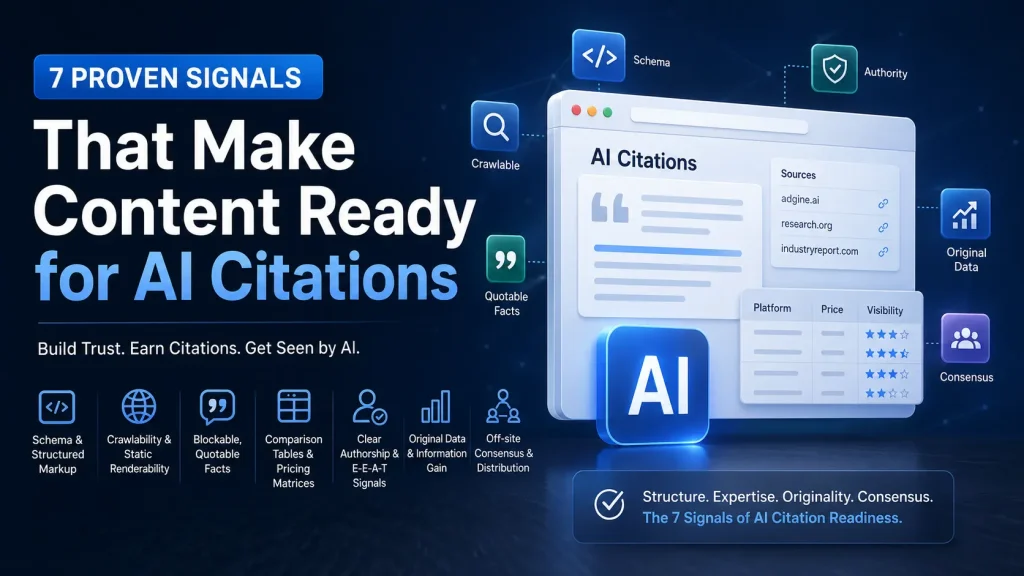
Generative search has redefined what it means for content to be “visible.” A page might rank on Google but still remain invisible to AI-powered answer engines like ChatGPT, Perplexity, or Google’s AI Overviews. Why? Because these systems seek clarity, structure, and trustworthy signals they can cite confidently. This article explores seven proven AI citation signals that make your content citable—the same factors Adgine’s data-backed framework uses to help brands build generative visibility. From schema markup to original insights, each signal strengthens your content’s readiness to be referenced as a primary source in AI-generated answers.
Strategic Overview
Traditional SEO alone is no longer enough. Generative engines rely on a smaller, more curated pool of trusted and structured sources. Topical depth, consistent authorship, and measurable information gain now matter more than keyword repetition.
Pages that don’t earn AI citations often fall short because they lack machine-readable formatting, explicit expertise indicators, or direct answers. To become AI-citable, content must prove both human authority and technical interpretability—what Adgine defines as AI citation readiness. If those signals are missing, teams should first diagnose AI citation gaps before deciding whether to rewrite, refresh, or build new content.
The following seven signals offer a practical roadmap for making your brand’s content retrievable, visible, and citable by AI-driven search and discovery systems.
Adgine’s Role in Optimizing Content for AI Citations
Adgine enables SEO, content, and growth teams to treat AI visibility as a measurable, repeatable process, with AI citation tracking capabilities that connect citation frequency, source quality, and prompt-level performance. Through its Generative Engine Optimization principles, Adgine benchmarks how AI platforms perceive a brand’s authority, tracks live citation frequency, and recommends schema-powered structures that increase citation likelihood responsibly.
GEO—the practice of optimizing brand assets for retrieval, relevance, and trusted citation by generative engines—focuses on transparent, explainable signals and verifiable expertise rather than algorithmic shortcuts.
Adgine’s GEO cycle typically includes:
-
Baseline brand perception and citation mapping
-
Competitor and topical footprint benchmarking
-
Schema and structural enhancement audits
-
Citation visibility measurement and iteration
This continuous feedback loop helps teams operationalize GEO through a repeatable GEO content optimization workflow. Adgine acts as a strategic copilot, connecting editorial expertise with machine-level clarity so content stays credible, structured, and consistently citable across AI ecosystems.
1. Schema and Structured Markup
Schema markup—such as FAQPage or Article schema—helps AI systems interpret a page’s structure, authorship, and purpose. Research shows schema-tagged pages receive several times more AI citations than unstructured ones.
At minimum, ensure each article includes:
-
Article schema with author, publish date, and update date
-
FAQPage schema if sections follow a Q&A format
-
Breadcrumb and WebPage schema to reinforce context and site hierarchy
| Schema Type | Purpose | Priority |
|---|---|---|
| Article | Identifies authorship and update cadence | Essential |
| FAQPage | Surfaces short-answer content blocks | Essential |
| Breadcrumb | Clarifies page hierarchy | Recommended |
| HowTo | Ideal for procedural or instructional content | Advanced |
| Product & Review | Adds structured commercial detail | Advanced |
Explicit structure increases AI confidence in extracting and citing your material accurately, especially when article sections include clear AI-ready definitions for key terms, entities, and claims.
2. Crawlability and Static Renderability
Even strong content fails if AI crawlers can’t access it. Crawlability ensures pages are discoverable and indexable; static renderability ensures text is readable without client-side scripts.
Many sites—nearly three-quarters—still block AI crawler agents or rely on dynamic frameworks that obscure content. To avoid that:
-
Allow AI and search bot access in your
robots.txt -
Test no-JavaScript rendering to confirm visible text
-
Use server-side rendering or prerendering for dynamic environments
-
Audit internal links to maintain uninterrupted crawl paths
Consider crawlability as the foundation—every other citation signal depends on it.
3. Blockable, Quotable Facts and Short Claim Sentences
AI models extract atomic facts, not entire paragraphs. Short, self-contained statements function as reliable citation anchors. Studies show that pages with concise, verifiable claims earn significantly more citations.
A quotable fact should:
-
Present one specific statistic or insight
-
Appear near the top of a section (answer-first structure)
-
Be understandable without surrounding context
Example improvement:
-
Before: “Many websites have crawling issues that prevent full indexing.”
-
After: “73% of websites block key AI crawler access.”
Clear claims signal authority and make extraction straightforward for AIs.
4. Comparison Tables and Pricing Matrices
Tables are among the most frequently cited elements in AI responses because they present structured, scannable relationships. Research indicates comparison tables raise citation visibility by nearly 50%.
Example:
| Platform | Monthly Cost | Citation Visibility | Best For |
|---|---|---|---|
| Adgine | $9.9-$499 | Real-time tracking | GEO and growth teams |
| SEO.com | $199 | Moderate | SMEs |
| Redot | $299 | High | Analytics-heavy brands |
Best practices: use descriptive headers, consistent formatting, and include at least one data-rich table within the first 500 words. This helps AI systems interpret relationships cleanly.
5. Clear Authorship and E-E-A-T Signals
AI models favor content backed by traceable expertise. E-E-A-T—Experience, Expertise, Authoritativeness, and Trustworthiness—now directly influences citation selection.
To reinforce these signals:
-
Display author names and professional credentials
-
Link bylines to complete bios or LinkedIn profiles
-
Attribute primary and peer-reviewed sources clearly
In regulated categories, visible credentials dramatically affect citation rates. Author identity should be verifiable, not implied.
6. Original Data and Information Gain
Information gain—as described in Google’s patent on information gain scores—measures how much distinct, valuable knowledge your content adds beyond existing sources. It’s one of the strongest predictors of AI citation readiness.
Pages incorporating proprietary data, real benchmarks, or primary case studies consistently outrank summaries. AI engines prefer them because they introduce new factual entities. High-performing pages maintain about 20% entity density—more unique facts per word.
To improve this signal:
-
Publish original charts or survey findings
-
Summarize proprietary methods early in the article
-
Use named entities (dates, tools, people, datasets) precisely
When content contributes new information, AIs treat it as an authoritative reference.
7. Off-site Consensus and Cross-Channel Distribution
AI citation authority extends beyond your own site. Models evaluate off-site consensus—how consistently your content or data is echoed on vetted platforms.
Current high-impact channels include Reddit, LinkedIn, and YouTube, where discussion threads and expert citations build collective trust.
| Channel | Citation Influence | Best Use |
|---|---|---|
| Very High | Topical discussions & community validation | |
| High | Expert commentary & research sharing | |
| YouTube | High | Visual explainers & cited breakdowns |
| Medium | Moderate | Long-form thought leadership |
Encourage factual mentions and distribute insights across trusted spaces. Unified, cross-platform credibility strengthens AI recognition and citation frequency.
Frequently Asked Questions
What are the main signals that make content ready for AI citations?
Answer-first structure, schema markup, quotable facts, original data, expert authorship, and consistent updates make content citation-ready.
Why do structural and authoritative signals boost AI citation likelihood?
They help AIs interpret data confidently, ensuring your page is both verifiable and trustworthy for inclusion in responses.
How can I implement an answer-first content format effectively?
Lead with a concise answer before expanding with data or context—Adgine’s GEO workflow applies this pattern systematically across content types.
What role does original data play in earning AI citations?
Original research or proprietary insight provides unique information gain, signaling to AI systems that your page is a primary source.
Do AI citation signals differ across platforms like ChatGPT and Perplexity?
All major engines value structure and authority, though weighting may differ—ChatGPT favors concise tables, while Perplexity emphasizes cross-source consensus.
Related Articles
10 Essential Steps to Refresh Old Articles for AI Search Success
In the era of AI-powered search engines, refreshing old content is essential to maintain visibility and relevance. This involves auditing articles for performance, updating facts and visuals, improving clarity, enhancing topical depth, and optimizing metadata. Implementing these practices ultimately supports both user engagement and AI interpretation, ensuring content remains authoritative and accessible.
7 Proven Steps to Write Content for AI Search Engines
AI-powered search is transforming information discovery and citation. Content optimization for AI engines like ChatGPT involves clear, structured answers and original data. A seven-step guide details strategies to create trusted, machine-readable content. Key practices include concise responsiveness, structured formatting, author credibility, and regular updates to enhance visibility and reliability in AI-generated responses.