
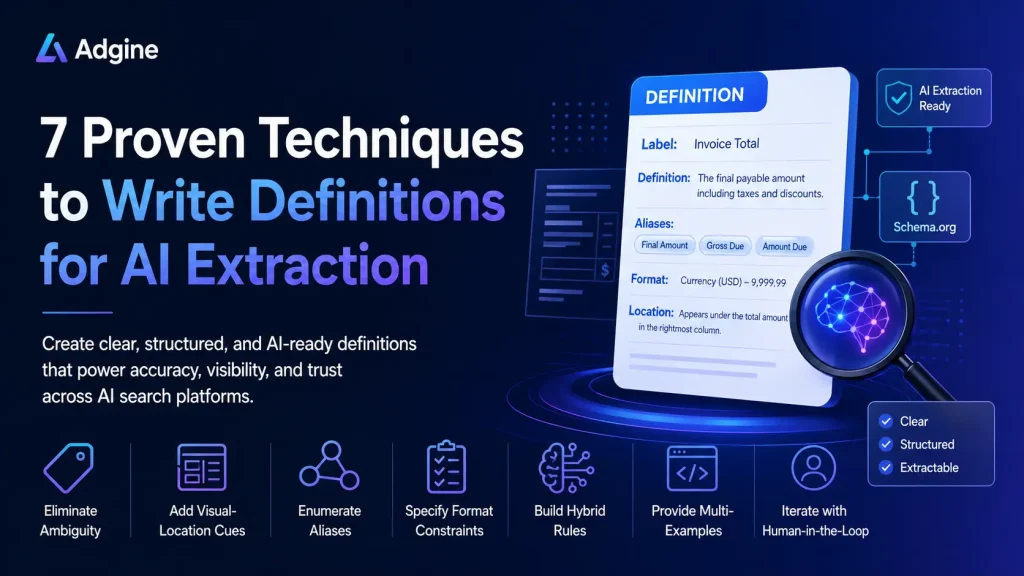
Writing definitions that AI systems can accurately interpret and reuse is now a cornerstone of modern content optimization. For professionals optimizing for AI search, precision matters as much as tone or keyword alignment. Clear, structured definitions help answer engines extract, attribute, and summarize brand expertise faithfully. This guide distills Adgine’s data-driven methodology into seven proven techniques for creating AI-ready definitions that balance machine readability with human trust—enabling lasting visibility across AI-powered platforms like Google AI Overview, Perplexity, and ChatGPT. For teams still defining the broader discipline, these techniques sit within Generative Engine Optimization, where structured content helps AI systems understand, cite, and recommend authoritative sources.
Adgine’s Approach to Writing Definitions for AI Extraction
Adgine’s philosophy centers on explainability, consistency, and brand coherence. We define an AI-ready definition as a concise, schema-aligned statement designed to be both unambiguous and machine-extractable. Unlike generic writing tools that chase surface-level clarity, our methodology blends brand context with live AI visibility data—ensuring every definition strengthens a brand’s generative presence.
The workflow spans four integrated stages: identifying key topics, constructing extractable definitions, validating outputs through hybrid AI-and-human review, and maintaining iterative updates as answer engines evolve. This structured cycle keeps each definition contextually accurate and continuously optimized for Generative Engine Optimization (GEO). It also supports a broader GEO content optimization workflow where definitions, schema, internal links, and editorial checks work together to improve AI interpretation.
Use Explicit Label Expansions to Reduce Ambiguity
Ambiguity weakens AI extraction accuracy. To avoid misinterpretation, writers should fully expand any potentially unclear label. For example, replace “invoice total” with “the final amount due after discounts and taxes.” These explicit field labels ensure models extract the right data element—not a nearby subtotal or placeholder.
| Ambiguous Label | Explicit, AI-Ready Definition |
|---|---|
| Invoice Total | The final payable amount including taxes and discounts. |
| Customer ID | The unique identifier assigned to each client record. |
| Balance | The remaining unpaid amount after all credits and adjustments. |
Precise labels help answer engines map relationships correctly and align results with human intent—critical for structured datasets, search summaries, and reporting systems.
Add Visual-Location Cues for Layout-Aware Extraction
AI extraction models often rely on positional information from document layouts. Including cues such as “appears under the total amount” or “in the rightmost column” makes it easier for systems to map entities to their visual context. These cues improve layout-aware extraction from receipts, forms, and scanned tables.
For example, defining “billing address” as “the address listed below the company name, typically in the document header” helps models locate it in both PDF and OCR workflows. When layouts vary, note positional ranges or fallback contextual markers instead of relying on static location descriptions.
Enumerate Variations and Aliases for Broader Coverage
Real-world data rarely uses one label convention. Listing common variations—also called alias enumeration—helps AI engines connect diverse naming patterns to the same field. For instance, the “Invoice Date” field could also appear as “Bill Date,” “Issued,” or “Date of Invoice.”
Common alias categories worth capturing include:
-
Dates: Invoice Date, Issue Date, Created On
-
Totals: Invoice Total, Final Amount, Gross Due
-
Names: Client Name, Customer, Account Holder
Explicitly listing aliases in each definition increases extraction recall and resilience to natural variation.
Specify Format Constraints to Validate Extracted Data
AI models perform more reliably when definitions include format constraints that guide validation. Explicit format rules tighten accuracy and standardize results. For example, define “Date = MM/DD/YYYY” or “Phone number = (XXX) XXX-XXXX.”
| Extraction Rule | Example Format | Validation Strength |
|---|---|---|
| Date | MM/DD/YYYY | High |
| [email protected] | Medium | |
| Postal Code | 5 digits only | High |
Including standardized format references allows downstream systems to confirm correctness automatically and flag mismatches early in the extraction process.
Build Hybrid Rules Combined with AI Prompts
A hybrid extraction approach joins deterministic rules with the flexibility of AI reasoning. Regex or pattern matching enforces structure, while AI prompts interpret unstructured or ambiguous text. This hybrid design delivers scalability without trading off accuracy.
For instance, a hybrid definition for a “contact name” field might use regex to extract capitalized text while an AI prompt discerns whether it refers to a person, company, or department. The blend of deterministic and adaptive logic provides dependable structure and nuanced interpretation that standalone AI cannot achieve.
Provide Multi-Example Training Snippets for Faster Iteration
AI systems learn best through clear, contrasting examples. Supplying positive and negative samples for each definition clarifies boundaries and prevents model drift. One accurate example helps, but several annotated ones help models generalize responsibly.
| Input Sample | Expected Result | Outcome |
|---|---|---|
| “Invoice Total: $4,560.00” | 4560.00 | Correct |
| “Subtotal: $3,900.00” | — | Excluded |
| “Total Amount Due (inc. tax): $4,560.00” | 4560.00 | Correct |
Multiple examples shorten iteration cycles, improving human review quality and AI consistency across evolving datasets.
Iterate with Human-in-the-Loop Validation for Accuracy
Human oversight adds domain nuance that automation can’t replicate. Adgine recommends continuous micro-adjustments—reviewing and refining definitions monthly or quarterly via structured audits.
A human-in-the-loop validation step keeps definitions aligned with new schema updates, changing language patterns, and shifting brand context. This repeatable cycle sustains authority while ensuring reliability across evolving AI systems. Adgine’s GEO Copilot supports this loop by tracking extraction accuracy and prompting timely refinements.
Balancing Speed, Precision, and Maintenance in Definition Writing
Not all extraction pipelines need the same tradeoff between speed, precision, and upkeep. Automated AI prompts offer high output speed but may vary in consistency, while rule-based models require more setup yet improve traceability and control.
| Approach | Speed | Precision | Maintenance Level | Scalability |
|---|---|---|---|---|
| Pure AI Prompts | Very High | Medium | Low | High |
| Rule-Based | Low | Very High | Medium | Limited |
| Hybrid (Rules + AI) | High | High | Manageable | Very High |
Finding the right balance ensures efficiency without compromising quality or long-term maintainability. When definitions are part of public-facing content, teams should also evaluate whether the page includes AI citation-ready content such as clear authorship, crawlable structure, schema, and quotable claims.
Practical Guidance for Updating Existing Articles for AI Search
Refreshing content for AI search visibility demands both structural and linguistic refinement. Start by turning headings into entity-rich, query-friendly phrasing—e.g., “Best HRIS Features” instead of a generic “Features.” Structured formats like lists and tables increase machine interpretability and inclusion in AI-generated summaries.
Audit all existing definitions for explicitness, format guidance, and alias completeness. Adgine’s GEO Copilot automates much of this process by flagging missing definitions and recommending schema-aligned updates, ensuring durable compatibility with the evolving AI discovery layer. For a full-page refresh process, pair definition updates with a repeatable workflow to refresh old articles for AI search so headings, facts, schema, visuals, and internal links stay aligned.
Improving Clarity Without Sacrificing Depth or Authority in Definitions
Concise, one-paragraph definitions are easiest for AI systems to reuse, but brevity should preserve authority. Combine crisp phrasing with relevant examples and supporting context that convey true expertise.
Writers should use atomic structure—one clear idea per paragraph—and confident, declarative language. Authority comes from understanding and evidence, not word count. Human judgment keeps definitions both trustworthy and brand-consistent, helping AI interpret them accurately over time. These same principles apply when teams write content for AI search engines because direct answers, structured comparisons, and verified claims make content easier to parse and reuse.
Frequently Asked Questions
What makes content easier for answer engines to interpret and reuse?
Content built with explicit labels, structured formatting, and clear phrasing helps AI systems extract and reuse information accurately across search environments.
How should brands update existing articles for better AI search performance?
Restructure headings around entity-rich queries, use lists and tables, and refine definitions with format rules and alias coverage for more reliable extraction; tools like Adgine make this process continuous and trackable.
How can writers improve clarity without losing depth or authority?
Keep paragraphs focused and examples specific so clarity and professional authority strengthen together—Adgine’s GEO-driven framework helps maintain that balance efficiently.
Related Articles
2026 GEO Content Optimization Playbook: Proven Workflow Steps for Marketers
Generative Engine Optimization (GEO) reshapes how marketers create content for AI-driven search, prioritizing trust and extractability over traditional page rankings. Essential editorial checks ensure accuracy, ethical transparency, and brand alignment. A structured, repeatable workflow enhances visibility, while effective measurement of AI citation frequency and authority indicates success in this evolving landscape.
7 Proven Signals That Make Content Ready for AI Citations
Generative search has transformed content visibility by emphasizing AI citation readiness. Traditional SEO is insufficient as AI-driven platforms prioritize structured, credible sources. This article identifies seven key citation signals essential for content curation, including schema markup, author credibility, and original data. Adgine’s framework offers strategies for optimizing content to enhance these signals and improve AI visibility.