2026 Guide to Monitoring Competitor Brand Mentions Across AI Platforms

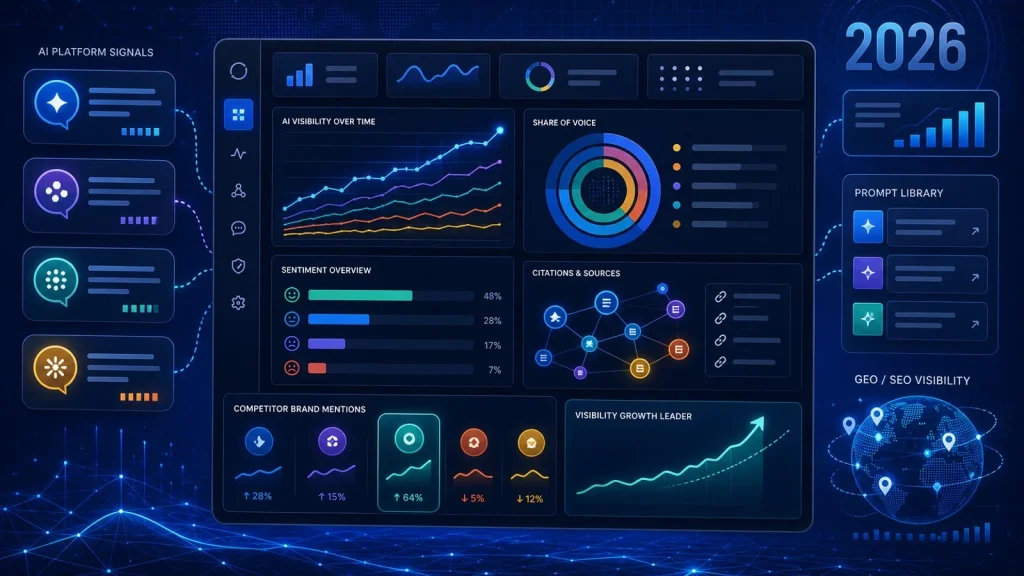
Artificial intelligence has become the new front door of discovery. Whether users ask for product recommendations in ChatGPT, comparisons through Perplexity, or contextual summaries within Google AI Overviews, these generative systems determine which brands appear in their synthesized responses. Monitoring competitor mentions across AI platforms is now a core part of visibility strategy for SEO, PR, and growth teams. This guide outlines a structured 2026 approach to identify missing mentions, benchmark share of voice, and turn AI insights into measurable visibility and revenue growth.
Defining AI Platforms and Monitoring Goals
AI platforms in this context refer to conversational and generative engines—such as ChatGPT, Gemini, Perplexity, Claude, and Google AI Overviews—that generate synthesized answers instead of traditional search listings. Tracking presence within these responses requires new metrics: brand mention frequency, placement within generated text, sentiment tone, and whether your name is cited or simply referenced. These signals should be connected to broader AI visibility metrics so teams can understand not just whether a brand appears, but how strongly it is represented across AI-generated answers.
Traditional keyword ranking tools can’t capture this nuance because AI answers have no static results. Instead, brands must understand how often and where they are surfaced within dynamically generated content.
The first step is setting clear goals. Determine which engines most influence your audience and define which outcomes you want to move—visibility, competitor displacement, regional reach, or direct pipeline contribution. For example, monitoring “ChatGPT recommendation results in North American SaaS queries” could be one strategic objective. As adoption accelerates—hundreds of millions of generative responses are now indexed—this discipline becomes foundational to marketing alignment (industry analysis).
Building a High-Value Prompt Library for AI Tracking
A well-structured prompt library underpins every effective monitoring initiative. Unlike static keywords, prompts represent real questions buyers ask AI assistants during their decision journey. This allows precision tracking at the prompt level across engines.
Begin with 50–500 prompts tied to your brand’s core services. Organize them by search intent:
| Intent Type | Example Prompt |
|---|---|
| Comparison | “Best project management platforms for large agencies 2026” |
| Recommendation | “Top-rated CRM tools for startups under $100/month” |
| Problem-Solving | “How to automate lead scoring with [Brand/Tool Name]?” |
| Informational | “What is the future of email automation in 2026?” |
Because generative engines often vary responses, each prompt should be tested multiple times to measure answer diversity. High-value prompts reflect strong intent—purchase comparisons, evaluations, or solution-based queries directly linked to growth goals. Adgine’s GEO workflow automatically structures prompt libraries and tracking queries like these, helping teams capture consistent insights across multiple AI engines.
Selecting the Right Tools for Competitor Brand Mention Monitoring
Tracking AI visibility requires tools designed for generative ecosystems, not legacy SERP scrapers. Look for platforms offering multi-engine coverage, prompt-level analytics, citation mapping, sentiment detection, and real-time alerting. Teams evaluating the market can use dedicated AI brand mention monitoring tools to compare capabilities such as prompt tracking, share-of-voice analysis, citation monitoring, and alerting.
Evaluate tools based on scale:
-
Enterprise: Advanced segmentation, historical benchmarking, and attribution modeling
-
SMB: Streamlined dashboards, quick setup, and data-driven recommendations grounded in GEO (Generative Engine Optimization) principles
When comparing solutions, consider the following:
| Tool Feature | Purpose | Example Use |
|---|---|---|
| Engine Coverage | Checks where your brand appears | ChatGPT, Gemini, Perplexity |
| Prompt Analytics | Measures share and sentiment | Trendlines by topic |
| Citation Mapping | Identifies linked sources | Monitors backlink opportunities |
| Alerting | Tracks new or dropped mentions | Weekly email digests |
Adgine, built specifically for GEO, integrates all these capabilities—from AI engine monitoring to citation and performance tracking—into one structured workflow that connects discovery data to content execution. Systematic AI mention monitoring can lead to significant visibility gains, with some teams seeing measurable brand awareness and conversion improvements within weeks.
Running Baseline Reports and Synthetic Tests Across Engines
Once your prompt library is finalized, run a structured baseline. Synthetic tests use automated prompts to simulate user queries and log mention results across multiple AI engines.
For each prompt, document:
-
Brand and competitor mentions
-
Placement and prominence in response
-
Presence of citations or links
-
Sentiment associated with each brand
Visualize this data in dashboards to gauge competitive positioning. During this stage, calculate AI share of voice**—the percentage of total mentions your brand earns compared to peers. High-performing brands often hold a 15–30% share in their niche, signaling strong AI-driven authority. Teams should also measure AI visibility trends over time so one-off snapshots become a repeatable performance benchmark. Adgine’s AI visibility reporting simplifies this process, producing consistent share-of-voice data that’s easy to analyze and act on.
Transforming Monitoring Data into Content, SEO, and GEO Strategy
Mention data becomes valuable only when it drives optimization. Connect your monitoring results directly to GEO and SEO workflows:
-
**Identify content gaps: Prompts where your brand is missing often indicate topical or structural deficiencies.
-
Refine SEO: Update weak pages, build new assets targeting high-intent prompts, and improve markup for better AI parsing.
-
Close the loop: Feed these insights into your CMS or content pipeline so teams can prioritize visibility fixes efficiently.
Brands that embed this closed-loop GEO cycle—collecting data, optimizing, and revalidating—see faster citation growth and improved buyer engagement. With roughly 15% of organic discovery expected to come from AI channels by late 2026, aligning with AI-driven visibility is now a direct lever for performance. Adgine automates this loop, connecting prompt tracking with actionable content recommendations inside one workspace.
Tracking Competitor Mentions to Benchmark and Gain Share of Voice
Benchmarking competitors across AI engines helps quantify progress with precision. AI share of voice measures how often your brand appears versus competitors within generative results. Go deeper by analyzing:
-
Mention type (primary, secondary, supporting)
-
Sentiment polarity (positive, neutral, negative)
-
Citation quality (linked or unlinked references)
Dashboards that visualize these factors show where visibility surges or declines. Advanced platforms like Adgine include regional and sentiment filtering, giving teams a complete picture of brand perception as AI engines localize results globally.
Operationalizing Improvements: Citation Building and Content Optimization
Turning insights into action depends on repeatable workflows. For every gap or low-quality mention identified, create a corrective plan:
| Action | Impact |
|---|---|
| Build or update authoritative long-form content | Improves relevance and citation likelihood |
| Strengthen backlinks from credible domains | Reinforces domain authority for AI ranking |
| Implement schema markup | Enhances citation recognition |
| Submit updated content to indexing tools | Speeds knowledge integration |
| Currently, fewer than 25% of ChatGPT’s brand mentions contain clickable citations—proof that linked authority remains underdeveloped. Elevating citation-friendly content and sources converts AI visibility into measurable growth. Teams that need deeper diagnostics should evaluate their AI citation tracking capabilities to understand which pages, sources, and entities are most likely to be cited. | |
| Adgine streamlines this process by tracking citations automatically and scoring content for citation-readiness within your category. |
-
Tip: Review Google’s guidance on link best practices to improve citation quality and discoverability.
-
Tip: Use Google’s structured data guidelines to implement schema markup for clearer entity recognition by AI systems.
-
Tip: After updates, request indexing via Google Search Console to accelerate knowledge integration.
Measuring Impact and Refining AI Visibility Efforts
Success depends on connecting visibility data to business results. Integrate AI tracking outputs with GA4 or unified analytics dashboards to trace full-funnel impact. Core KPIs include AI share of voice, visibility-to-conversion rate, citation growth, and sales cycle efficiency.
Use an iterative GEO rhythm: 30–90 day monitoring cycles, monthly reviews, prompt refinement, and continuous scaling. As AI search expands into multimodal formats (text, image, voice), maintaining adaptive measurement through platforms like Adgine will be critical for sustainable visibility across evolving AI channels. For teams comparing solutions, clear GEO platform evaluation criteria can help connect monitoring requirements with content execution, citation tracking, and business reporting.
Frequently asked questions
What key metrics should brands track in AI competitor mention monitoring?
Track mention frequency, share of voice, citation quality, sentiment polarity, and brand position within generated answers. Adgine centralizes these KPIs across engines.
How can teams identify missing mentions in important AI prompts?
Run targeted prompts, review results, and log where your brand is absent. Adgine automates these queries, highlighting missing visibility automatically.
How does brand mention tracking influence content and SEO strategies?
It uncovers underrepresented themes and guides GEO-driven updates to strengthen authority and visibility across AI results.
What steps help benchmark against competitors across AI platforms?
Establish baseline share of voice, monitor shifts, and compare sentiment patterns over time using structured dashboards such as those in Adgine.
How long does it take to see results from AI mention monitoring and optimization?
Most teams notice measurable gains within weeks once structured monitoring and GEO-informed optimization cycles are in place through Adgine.
Related Articles
What is Generative Engine Optimization?
Generative Engine Optimization (GEO) is essential for brands to gain visibility in AI-driven searches, focusing on content that AI systems can easily cite. Unlike traditional SEO, GEO targets AI citations and emphasizes structured, factual content. With AI referrals growing, brands must adapt to ensure relevance and authority in the evolving digital landscape.
The Definitive Guide to Crafting a Data‑Driven GEO Strategy
Generative Engine Optimization (GEO) is a pivotal strategy for brands focusing on visibility within AI-powered search environments. Unlike traditional SEO, GEO emphasizes entity recognition, trust signals, and citation frequency in AI-generated content. A comprehensive GEO program integrates structured data, optimized content, and cross-functional collaboration to enhance brand references in generative responses.