
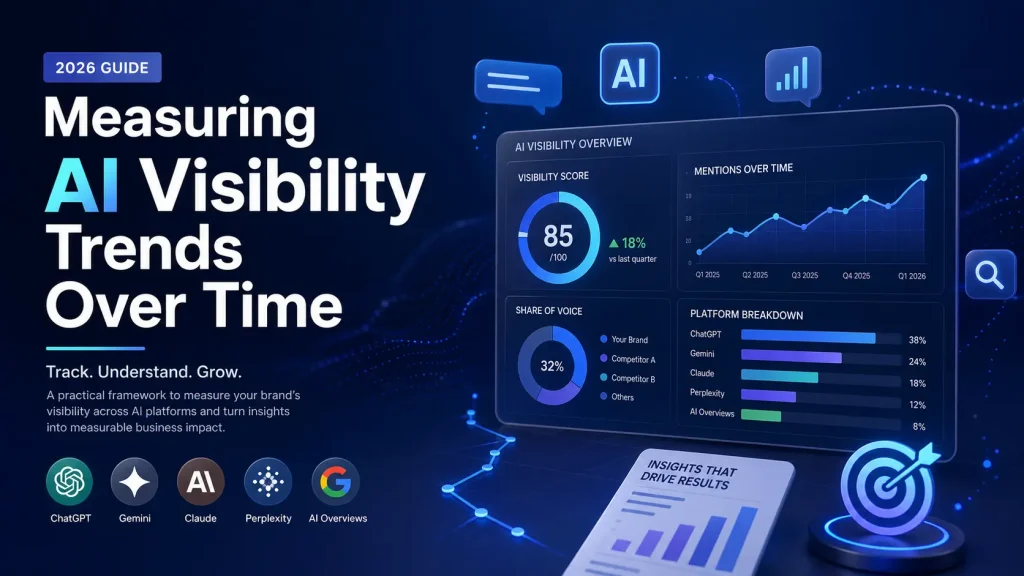
As AI search and generative discovery become central to how users find information, understanding and improving your brand’s AI visibility is now a core growth function. Measuring visibility trends over time reveals where your brand appears in AI-driven recommendations, tracks authority shifts across systems like ChatGPT and Perplexity, and links these patterns to measurable business impact. This guide explains how to establish a reliable foundation, define meaningful metrics, and apply data-backed methods to sustain visibility in the evolving AI ecosystem of 2026.
Understanding AI Visibility and Its Importance
AI visibility refers to how often and accurately your brand, products, or content appear in responses and recommendations from systems such as ChatGPT, Gemini, Claude, and Google AI Overviews. It reflects both the quality and quantity of your brand’s presence across AI-powered search contexts.
This matters because AI discovery is reshaping user behavior—reducing clicks but amplifying brand authority when inclusion occurs. Teams that measure AI visibility can assess not only reach but influence: the likelihood that an AI system cites or recommends their brand as a trusted source. Yet most organizations still overlook this metric, leaving opportunity for those that track it systematically.
In short, AI visibility measures how frequently and faithfully a brand is represented within AI-generated outputs across digital channels. Tracking it ensures that as search shifts to conversational queries, your brand remains visible, accurate, and credible in the AI discovery layer. For teams that need a stronger measurement foundation, start with a clear definition of AI visibility metrics before building dashboards or reporting cadences.
Establishing a Baseline for AI Visibility Measurement
A strong measurement approach starts with a clear baseline. Teams should begin by using specialized AI visibility tools—such as Adgine—to benchmark current performance before scaling into enterprise dashboards. At this stage, gather data such as:
-
Frequency of citations by major AI systems
-
Top URLs and topics surfaced alongside your brand
-
Sentiment or tone of mentions
-
Visibility distribution by platform
Document findings in a structured table to visualize initial patterns:
| AI Platform | Top Cited Pages | Mention Frequency | Sentiment |
|---|---|---|---|
| ChatGPT | /solutions/ai-analytics | 18 | Positive |
| Perplexity | /about-us | 12 | Neutral |
This baseline serves as your reference point for long-term benchmarking and quarterly optimization reviews.
Selecting AI Platforms and Prompts to Track
With hundreds of AI engines now surfacing content, prioritize those driving meaningful discovery. In 2026, the primary set includes ChatGPT, Google Gemini, Claude, Perplexity, and Google AI Overviews.
To decide which prompts to monitor:
-
Conduct audience research to identify core conversational queries in your industry.
-
Review community spaces like Reddit or Q&A hubs such as Stack Exchange to capture real-world phrasing.
-
Test synthetic prompts around strategic topics to simulate likely AI-generated results.
Balancing authentic queries with structured test prompts helps map not just presence but visibility gaps across engines.
Capturing AI Visibility Data: Front-End and Synthetic Probing
AI visibility data collection typically combines two complementary methods:
-
Front-end monitoring – Capturing AI responses through emulated user sessions or headless browsers.
-
Synthetic probing – Sending structured prompts via APIs or custom scripts for precise tracking.
A blended approach offers a fuller picture, since AI outputs vary by context, region, or wording. Establish a recurring monitoring cycle:
| Action | Tool Type | Frequency | Purpose |
|---|---|---|---|
| Screenshot summary | Front-end monitor | Weekly | Track natural answer inclusion |
| API query test | Synthetic probe | Daily | Measure result consistency |
| Sentiment scan | Dashboard plugin | Biweekly | Capture tone and context |
This multi-layered approach yields data that’s both stable and actionable. Platforms like Adgine automate much of this workflow, reducing manual effort while maintaining accuracy, while dedicated brand mention monitoring tools help teams decide which engines, prompts, and competitors to track consistently.
Defining and Tracking Key AI Visibility Metrics
To move beyond surface-level reporting, focus on metrics that connect visibility to authority and outcomes:
| Metric | What It Measures | Why It Matters | Typical Method |
|---|---|---|---|
| Citation frequency | Number of times your brand appears | Reflects inclusion consistency | API logs, manual reviews |
| Share of voice | Brand visibility vs. competitors | Benchmarks authority in AI results and supports competitor brand mention monitoring | Comparative dashboards |
| AI visibility score | Weighted composite of mentions, accuracy, and sentiment | Creates a clear performance index | Proprietary scoring models |
| Sentiment and factual correctness | Tone and accuracy of mentions | Protects reputation from misinformation | NLP analysis, audits |
| Placement signals | Position in summaries or knowledge panels | Indicates level of trust | Structured data markers |
Together, these metrics reveal not just if you’re visible—but whether AI-driven exposure builds credibility that converts.
Integrating AI Visibility Insights with Business Analytics
To demonstrate impact, integrate visibility data directly into your analytics stack. Export AI visibility metrics into systems like Amplitude or Google Analytics 4 to tie mention trends to sessions, conversions, and revenue attribution.
This integration converts visibility signals into business intelligence. It also prevents the common issue of siloed dashboards without context. Regular integration checks—monthly or quarterly—ensure your dataset evolves as AI platforms adjust their retrieval methods and supports a broader data-driven GEO strategy tied to business outcomes.
Reviewing AI Visibility Performance: Recommended Cadence
AI ecosystems shift quickly. To stay aligned:
-
Analyze visibility weekly or biweekly to catch short-term fluctuations.
-
Conduct structured quarterly reviews to refine prompts, tracking tools, and metric definitions.
-
Maintain a live dashboard summarizing key trends for ongoing optimization.
This cadence helps teams stay adaptive as AI engines change output logic, while linking long-term visibility goals to measurable progress.
Optimizing AI Visibility Through High-Value Content Strategies
Improving AI visibility depends on expertise and clarity, not content volume. Focus on citation-worthy assets grounded in real-world authority. Best practices include:
-
Applying E-E-A-T principles: demonstrate expertise, experience, and trust.
-
Publishing research, explainers, or original insights that AI systems can cite confidently.
-
Earning authoritative backlinks and mentions across credible sites.
Audit existing assets to find materials ready for reformatting into AI-citable content. Platforms such as Adgine support this by identifying which topics and formats perform best across engines, then translating those findings into GEO content optimization actions.
Implementing Structured Data and Schema Markup for AI Understanding
Structured data—schema-based code describing entities and relationships—helps AI systems interpret your content accurately. Apply schema.org markup for Organization, Product, and FAQ elements to clarify meaning.
Maintain consistency across your site, metadata, and directories. Correct, unified schema improves how AI models extract information during summarization and training, strengthening your brand’s contextual reliability. For additional guidance, see Google’s introduction to structured data.
Scaling and Governing AI Visibility Measurement Workflows
As measurement matures, scale with structure:
-
Layer advanced monitoring and analytics tools into your stack.
-
Assign ownership for validation, insight generation, and reporting.
-
Conduct quarterly training on data interpretation and ethical standards.
For global or regulated sectors, include compliance and fairness audits to avoid bias. Refer to frameworks such as the NIST AI Risk Management Framework and the OECD AI Principles for definitional clarity and governance guidance. A transparent, well-governed workflow enhances reliability and positions your brand as a responsible participant in the AI visibility economy. Adgine enables teams to operationalize this governance within one end-to-end GEO workflow.
Common Challenges in Measuring AI Visibility and How to Overcome Them
AI outputs are inherently variable—identical prompts may yield slight differences. Measure patterns, not one-offs. Expand your sample size and rerun prompts to stabilize datasets.
No single tool covers all platforms equally, so combine front-end and synthetic monitoring for comprehensive results. Audit prompts and sentiment regularly, watching for biases or inconsistencies. Over time, structured tools like Adgine help normalize data and streamline interpretation.
Frequently asked questions
How can teams start measuring AI visibility effectively?
Use a baseline benchmarking tool such as Adgine to track brand mentions, sentiment, and prompt coverage across key AI engines, combining synthetic and manual checks for reliability.
How often should AI visibility performance be reviewed for optimal results?
Weekly or biweekly monitoring maintains agility, while quarterly reviews keep prompts and metrics aligned with evolving AI outputs.
What metrics best indicate meaningful AI visibility beyond vanity numbers?
Look at share of voice, sentiment accuracy, factual precision, placement quality, and revenue attribution from AI-sourced traffic.
How can content be improved to enhance AI visibility without sacrificing quality?
Develop authoritative, data-backed assets that address user intent transparently and reinforce brand expertise.
What role does integration with analytics platforms play in AI visibility measurement?
Integration connects AI visibility data with performance metrics, showing the real business value of improved presence in AI-driven results.
Related Articles
The Definitive Guide to Diagnosing AI Content Citation Gaps
AI-driven search platforms are crucial for content visibility, yet many brands are not cited in these sources. This guide outlines methods to diagnose and rectify citation gaps, emphasizing the importance of content structure, technical SEO, verifiable data, and continual monitoring to enhance AI recognition and authority.
2026 Guide to Monitoring Competitor Brand Mentions Across AI Platforms
Artificial intelligence has emerged as a crucial component in brand visibility strategies, shaping how products are discovered. This guide outlines a strategy for 2026 that emphasizes monitoring mentions across AI platforms, developing a prompt library, and utilizing appropriate tools for competitor benchmarking, ultimately transforming insights into actionable content and SEO strategies for enhancing brand awareness and revenue.