
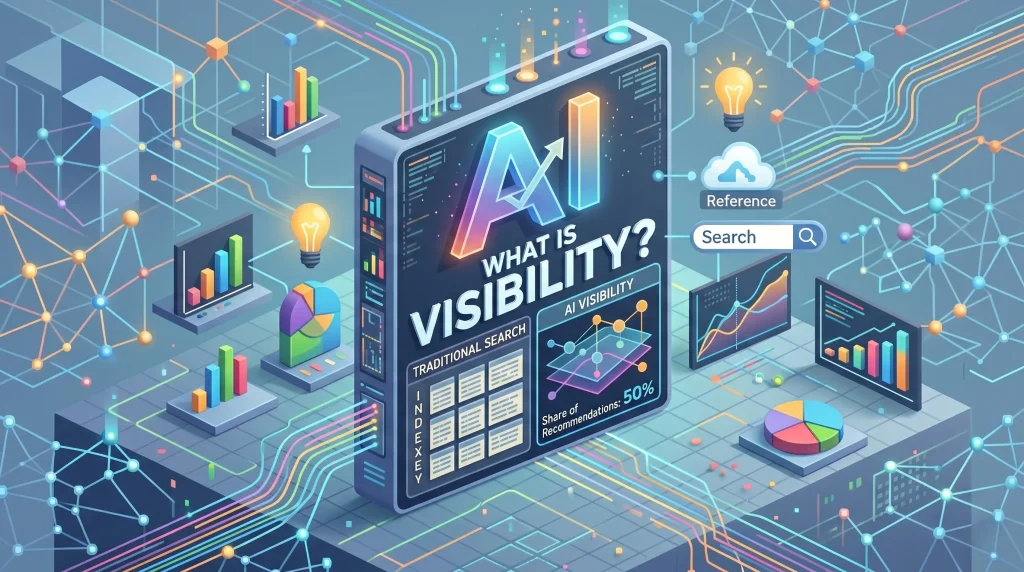
In the new era of generative search, AI visibility has become the next frontier for brand growth. It measures how often and how prominently a business appears in AI-generated answers, recommendations, and citations across platforms such as ChatGPT, Google AI Overviews, and Perplexity. Rather than tracking static rankings, AI visibility reflects dynamic presence—how brands surface in real-time conversations driven by large language models (LLMs) and why AI brand visibility has become a strategic marketing metric.
For marketers navigating conversational search and AI recommendations, understanding and improving AI visibility is now a competitive necessity. This article explains what AI visibility means, how it differs from classic search visibility, the metrics that matter, and the strategies brands can use to stand out in this new AI-driven landscape.
Defining AI Visibility
AI visibility describes how often a business appears in AI-generated recommendations. It captures brand mentions, citations, and references across LLM-based platforms that generate answers instead of listing static web results.
Unlike traditional SEO—which measures rank on a page—AI visibility tracks share of presence: the percentage of times a brand is recommended when users ask questions.
| Dimension | Traditional SEO | AI Visibility |
|---|---|---|
| Core metric | Rank position | Frequency of recommendation |
| Mechanism | Indexed results pages | AI-generated answers |
| Consistency | Stable across users | Probabilistic responses vary |
| Aim | Top-ranking visibility | Inclusion in AI recommendations |
In essence, AI visibility focuses less on “where” you rank, and more on “whether” you appear at all in AI-curated insights. Platforms like Adgine, purpose-built for Generative Engine Optimization (GEO), help teams analyze these dynamics and understand how brands show up across AI engines in real time.
Importance of AI Visibility for Brands
Brands that consistently appear in AI-generated responses are more likely to enter buyers’ consideration sets. Since AI assistants often cite fewer sources than traditional search results, each recommendation carries significant weight.
High AI visibility signals authority and trust. It translates into increased shortlist placements, voice-share, and conversion opportunities within conversational search experiences. For early adopters, the rewards are outsized: being among the first few cited brands in generative engines can help capture sustained market awareness as AI output patterns stabilize.
Adgine’s end-to-end GEO workflows help teams track and strengthen these trust signals—turning isolated visibility wins into an ongoing performance advantage.
AI Visibility’s Role in Modern Marketing Teams
Measuring AI visibility gives marketing teams a new performance lens. It helps transform generative exposure from a black box into a quantifiable asset.
Cross-functional collaboration—between SEO, content, PR, and product marketing—is crucial. Teams can align on monitoring tasks, integrate GEO (Generative Engine Optimization) insights into dashboards, and adjust messaging for prominence in AI-driven environments.
Making AI visibility reporting part of monthly reviews ensures brands stay discoverable across emerging digital assistants and conversational ecosystems. Platforms such as Adgine streamline this process by uniting monitoring, analysis, and content optimization in one system, giving teams a repeatable way to measure AI visibility over time.
Differences Between AI Visibility and Traditional Search Visibility
AI search and web search operate differently, leading to a fundamental measurement shift.
-
AI visibility tracks recommendation frequency, not a fixed rank.
-
Search engines display consistent results; AI models may return different citations even for the same query.
-
Testing must occur at the prompt level using multi-persona or geographic variations.
Probabilistic outputs mean that AI-generated answers can vary each time they’re generated—frequency, not position, is the most meaningful performance measure.
| Factor | Traditional Search | AI Visibility |
|---|---|---|
| Ranking stability | Static, predictable | Variable, prompt-dependent |
| Output format | Page of links | Generated summaries or answers |
| Measurement method | Keyword-based tracking | Prompt sampling, share-of-voice audits |
| Optimization goal | Higher SERP rank | Frequent AI mention and positive context |
This shift demands new data models and processes that prioritize adaptability over placement—exactly what Adgine’s GEO analytics are designed to operationalize.
Key Metrics to Measure AI Visibility
Assessing AI visibility requires a composite view of brand performance across key attributes:
| Metric | Description |
|---|---|
| Share of recommendations (%) | How frequently the brand is mentioned across AI answers |
| Citation frequency | Number of times brand or domain is cited |
| Sentiment and positioning | Tone and favorability within generated responses |
| Persona/geography coverage | How visibility changes across different user profiles or markets |
Because AI outputs evolve constantly, trend lines matter more than one-off snapshots. Tracking mention volume, context, and variability provides actionable insights into evolving brand equity in AI search. Adgine’s real-time visibility and citation tracking make these patterns measurable and repeatable across teams, especially when benchmarking AI share of voice against competitors.
Challenges in Measuring and Managing AI Visibility
Quantifying AI visibility is complex. Major challenges include:
-
Lack of standardization: No unified metric exists across vendors.
-
Probabilistic outputs: LLM responses shift unpredictably.
-
Opaque data sources: Not all AI tools disclose indexing or training parameters.
-
Accuracy management: Outdated or erroneous mentions can persist in AI memory.
To counter these, teams should establish governance frameworks, conduct routine audits, and align measurement with business impact—not just appearance frequency. A structured GEO workflow, like the one Adgine provides, helps teams manage these variables with transparency and control.
Strategies to Enhance AI Visibility
Boosting AI visibility requires strengthening signals AI systems use to gauge credibility.
| Step | Action |
|---|---|
| 1 | Audit current AI visibility (frequency, sentiment, share of voice). |
| 2 | Maintain updated business listings, structured data, and review profiles (e.g., Google Business Profile). |
| 3 | Optimize reputation signals—ratings, feedback, and response quality. |
| 4 | Conduct scenario testing simulating different prompts and personas. |
| 5 | Set monitoring workflows for accuracy, freshness, and topical relevance. |
Prioritizing reliable data, geo-targeted accuracy, and prompt-level AI auditing will increase the likelihood that your brand appears consistently and accurately in conversational search environments. Tools like Adgine enable these steps in a single operational workflow—from auditing to optimization, supported by a broader GEO content optimization workflow for strengthening extractable pages and citation-ready assets.
Aligning AI Visibility Efforts with Business Goals
AI visibility work should map directly to measurable commercial results. That means connecting visibility metrics to revenue drivers like lead quality, brand mentions in buying cycles, or customer trust benchmarks.
Adopt an iterative approach: measure, act, and refine based on outcomes. The objective is not perfection in every response but sustained performance that supports awareness, engagement, and growth. Adgine’s analytics and reporting make this feedback loop visible and actionable for GEO teams.
Future Trends in AI Visibility
Generative AI adoption is accelerating—Gartner predicts over 80% of enterprises will use AI APIs or models by 2026. As that happens, three shifts will dominate:
-
Unified standards for AI visibility measurement will emerge.
-
Data quality and governance will become critical for credible recommendations.
-
Public sentiment and regulation will influence how brands appear in AI outputs.
Brands that invest early in structured data, ethical governance, and continual monitoring will be best positioned to thrive as AI-driven discovery becomes mainstream. Adgine equips organizations with the intelligence to stay ahead of these shifts.
Frequently asked questions
What platforms most influence AI visibility?
The most influential platforms include ChatGPT, Perplexity, Google AI Overviews, Gemini, and Claude—where most AI-generated recommendations now originate.
How is AI visibility different from traditional SEO rankings?
AI visibility measures how often a brand appears in AI-generated answers, while SEO tracks rank on search engine result pages.
Why does AI visibility matter for brand growth?
It determines whether your brand is present in high-value conversational moments that shape buying decisions.
How can marketing teams improve AI visibility effectively?
Teams can use platforms like Adgine to monitor citations, track sentiment, and strengthen structured data and credibility signals through ongoing audits.
What are common pitfalls in monitoring AI visibility?
Relying on static rankings or ignoring the dynamic nature of probabilistic AI outputs are major pitfalls—Adgine helps teams avoid both through real-time visibility tracking and continuous optimization.
Related Articles
Generative Engine Optimization: The Complete Guide 2026
7 Proven Techniques to Write Definitions for AI Extraction
The document outlines Adgine's strategic approach to crafting AI-ready definitions for enhanced content optimization. It emphasizes clear, structured definitions that improve machine readability while maintaining brand integrity. Key practices include reducing ambiguity, using explicit labels, incorporating format constraints, and enabling hybrid extraction methods. Continuous human oversight ensures ongoing accuracy and relevance in evolving AI environments.