
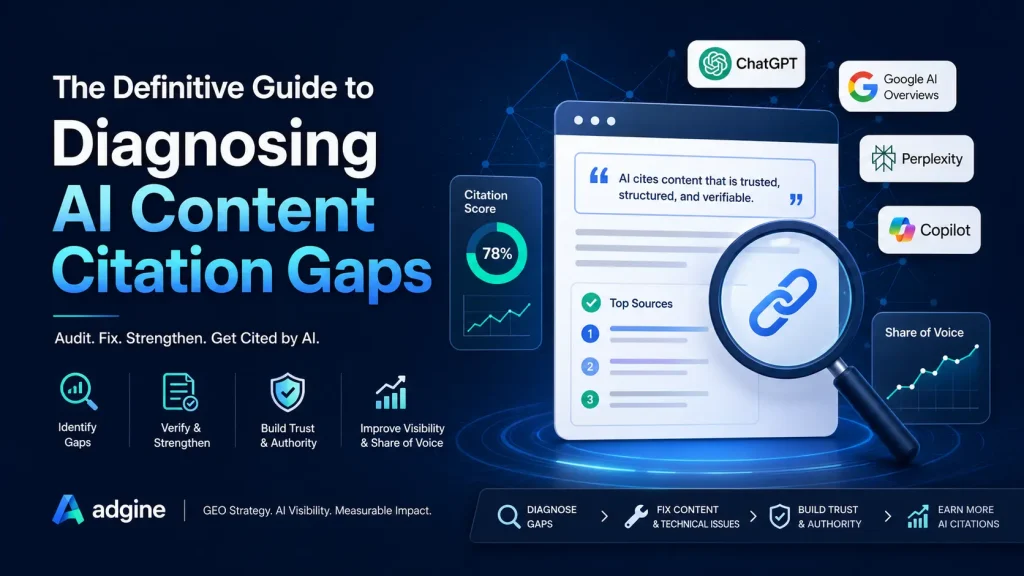
AI-driven search platforms such as ChatGPT, Google AI Overviews, and Perplexity are now key gateways to discovery. Yet, many brands find their content missing from these citations. Diagnosing why AI doesn’t cite your website requires both technical and editorial rigor—understanding how generative engines select sources and how you can optimize to appear among them. This guide provides a practical blueprint to audit, fix, and strengthen your content so that AI systems recognize and reference your brand as authoritative, verifiable, and trustworthy.
Understanding AI Content Citation and Its Importance
AI content citation refers to the process by which generative engines—like ChatGPT, Google AI Overviews, or Perplexity—select and reference external web sources to support their answers. These engines extract factual support from trustworthy, structured, and well-linked sites that provide verifiable data and contextual expertise.
For brands, being cited by AI means visibility during critical decision moments. When your content is absent, your share-of-voice in these answer engines shrinks, leading to potential misrepresentation or invisibility in key buyer stages. AI citation gaps can result in lost organic reach across review sites, forums, and third-party summaries that increasingly power purchase journeys. Adgine helps teams measure and close these citation gaps systematically by aligning GEO strategy with real-time AI visibility data, especially when those gaps are evaluated against clear AI citation readiness signals.
Step 1: Prioritize Business-Relevant Prompts and KPIs for AI Citation
Before diagnosing citation issues, align metrics with meaningful business queries. Start by mapping your critical user prompts across the funnel—awareness, consideration, and decision—and tailoring them to your core audience. A B2B software brand, for instance, might track prompts like “best SaaS analytics platforms” or “enterprise data dashboard tools.”
Build a KPI matrix that includes:
-
Share-of-voice in AI results for your domain
-
Frequency of citations across engines
Platforms that integrate prompt and citation analytics, such as Adgine, can provide unified dashboards showing how often your content appears in AI responses and what drives that visibility. Regularly track relationships between prompts and citation frequency to target refinements effectively.
Step 2: Conduct a Multi-Engine Citation Crawl to Identify Gaps
To understand where your brand stands, simulate real-world user queries across AI engines such as ChatGPT, Gemini, Google AI Overviews, Perplexity, and Copilot. Use tools that replicate genuine user behavior to capture unbiased results.
Extract citation data at both domain and URL levels. Segment by geography and language to uncover nuances—your site may perform well in one region but be overlooked elsewhere. Visualizing this data in a table helps reveal opportunity gaps:
| Engine | Top-Cited Domains | Citation Frequency | Your Domain Coverage |
|---|---|---|---|
| Google AIO | Competitor A, Competitor B | 27 | None |
| Perplexity | Industry Blog X | 14 | 2 URLs |
| ChatGPT | Aggregator Sites | 33 | 1 mention |
This level of granularity clarifies the scope of your visibility—or lack thereof. Adgine’s GEO visibility tracker can automate this process across multiple AI engines and deliver structured citation comparisons for faster diagnosis, while dedicated AI citation tracking tools help teams compare engines, cited URLs, and source quality at scale.
Step 3: Classify Citation Gaps by Root Cause
Not all citation gaps share the same underlying reason. Classify them into three categories:
-
Creation gaps: No existing high-quality page addresses the query or topic.
-
Refresh gaps: Outdated pages fail to satisfy evolving prompts or are overshadowed by newer content, making it important to refresh old articles for AI search when facts, structure, or intent coverage fall behind.
-
Outreach gaps: Third-party mentions dominate because your brand lacks exposure in relevant communities or syndication networks.
A citation gap is the absence or underperformance of your content within the AI-cited sources relevant to your business. Mapping each gap to its cause helps prioritize fixes that yield measurable impact with minimal wasted effort.
Step 4: Verify Citations and Claims with Trusted Tools
Accuracy and provenance are essential. Verification ensures AI systems and readers trust your contributions. Citation verification occurs on three levels:
-
Passage-level: Validates the precise text snippet supporting a claim.
-
URL-level: Confirms citations point to live, credible pages.
-
Paper-level: Validates entire studies or documents.
Use validation tools such as Scite for “smart citations” that classify evidence as supportive or contradictory, Elicit for academic metadata, and Atlas for passage-level checks. Embedding this discipline into your content workflow—something Adgine’s GEO Copilot can support—prevents misinformation and strengthens authority signals over time.
Step 5: Analyze Common Content Issues That Prevent AI Citation
Vague or Missing Content Structure and Headers
If AI engines can’t parse your structure, they can’t cite it. Use a clear hierarchy of headers, short paragraphs, and concise section summaries. Each major idea should live under an H2 or H3 heading that states the key insight upfront.
Lack of Verifiable Data and Deep Citations
AI search prefers sources that reference verifiable data—information directly linked to credible sources or primary datasets. Every claim should reference published research or authoritative documents. Include fact boxes summarizing key data points and link transparently to originals.
Weak or Absent Topical Authority and Internal Linking
Topical authority signals trust. Build interconnected content clusters around your main themes. Implement contextual links among related articles, case studies, and guides to reinforce semantic relevance. Verify each page identifies its authors, reflects expertise, and maintains consistent entities for maximum AI recognition. Adgine’s workflow encourages these authority-building structures within every GEO content optimization workflow.
Step 6: Address Technical SEO Barriers to AI Crawling
Improve Page Crawlability and Accessibility
Check that key pages aren’t blocked by robots.txt or meta tags. Ensure internal linking exposes essential information paths and simulate AI crawls to verify end-to-end discoverability.
Implement Robust Schema Markup for AI Understanding
Structured data clarifies meaning. Use schema types like Article, FAQ, or HowTo to annotate your content and business entities. Validating JSON-LD scripts improves interpretability and helps AI engines align your content with user intent.
Fix Performance Issues that Block AI Access
Page speed matters. Optimize Core Web Vitals, compress resources, and remove unnecessary scripts. Monitor uptime and Time to First Byte to prevent AI crawlers from timeouts or incomplete scans.
Step 7: Strengthen Trust Signals and E-E-A-T Authority
Ensure Clear Authorship and Expertise
Every page should clearly state who created it and why they’re qualified. Include bios with credentials, publications, and relevant background—especially for technical or regulated topics.
Add Visible Trust Content and Certifications
Display badges, reviews, and compliance certifications. Third-party verification amplifies perceived reliability—not only for users but also for AI systems assessing content quality.
Maintain Consistent Brand and Entity Signals
Ensure consistent use of names, logos, and descriptors across content and structured data. Entity signals are the standardized identifiable mentions of your organization, products, or experts that allow AI systems to connect all references confidently to your brand identity. Adgine’s entity-mapping tools help teams maintain this consistency across domains and content types.
Step 8: Improve Page-Level Content to Increase AI Citation Chances
Structure Content into Machine-Readable Knowledge Units
Break content into atomic paragraphs—each 2–4 sentences focusing on one clear idea. Begin sections with a Bottom-Line-Up-Front summary so AI and readers understand the takeaway immediately.
Use Clear, Descriptive Headers and BLUF Summaries
Effective headers state what the section delivers (“How Schema Markup Boosts AI Visibility”), improving both readability and citation likelihood. Bullet points and tables make structured insights more extractable for AI indexing.
Optimize for Factual Accuracy and Citation Readiness
Each claim should have traceable evidence. Maintain a “citation readiness” checklist including updated facts, reliable sources, accurate cross-links, and refreshed data sets. Make this process routine within your editorial workflow. Adgine enables this checklist approach directly within its GEO content engine.
Step 9: Monitor, Measure, and Iterate Your AI Citation Performance
Generative Engine Optimization (GEO) is never static. Configure dashboards that integrate multi-engine citation tracking, prompt-based visibility metrics, and share-of-voice trends. Set a quarterly review rhythm where you reassess top prompts, address new content gaps, and feed learnings into updated content briefs.
A continuous feedback loop from analytics to editorial actions keeps your content ecosystem adaptive and AI-citation-ready over time. Adgine is purpose-built to manage this GEO lifecycle—from topic planning to real-time AI citation tracking and performance optimization.
Frequently Asked Questions
What are the main reasons my content is not cited by AI systems?
Common causes include weak topical authority, poor structure, lack of verifiable data, or technical barriers. Adgine helps uncover which of these factors most affect your visibility.
How can structured data improve my chances of AI citation?
Schema markup clarifies meaning and relationships in your content, making it easier for AI systems to identify and cite reliable sources.
What tools are effective for tracking AI content citations?
Adgine provides integrated multi-engine citation tracking and share‑of‑voice analytics designed for GEO performance monitoring.
How often should I audit my site for AI citation gaps?
A quarterly audit is best, especially after major content or structural changes.
Can improving topical authority increase AI citations?
Yes. Expanding expert coverage and strengthening internal links helps AI systems interpret your site as a trusted, authoritative source—an approach Adgine’s GEO workflow supports end‑to‑end.
Related Articles
What is Generative Engine Optimization?
Generative Engine Optimization (GEO) is essential for brands to gain visibility in AI-driven searches, focusing on content that AI systems can easily cite. Unlike traditional SEO, GEO targets AI citations and emphasizes structured, factual content. With AI referrals growing, brands must adapt to ensure relevance and authority in the evolving digital landscape.
GEO vs SEO: What’s the Difference?
GEO (Generative Engine Optimization) and SEO (Search Engine Optimization) serve distinct yet complementary roles in digital marketing. SEO focuses on improving rankings in traditional search engines, while GEO ensures content is cited by AI systems in generated summaries. Integrating both strategies enhances brand visibility and credibility across various platforms.